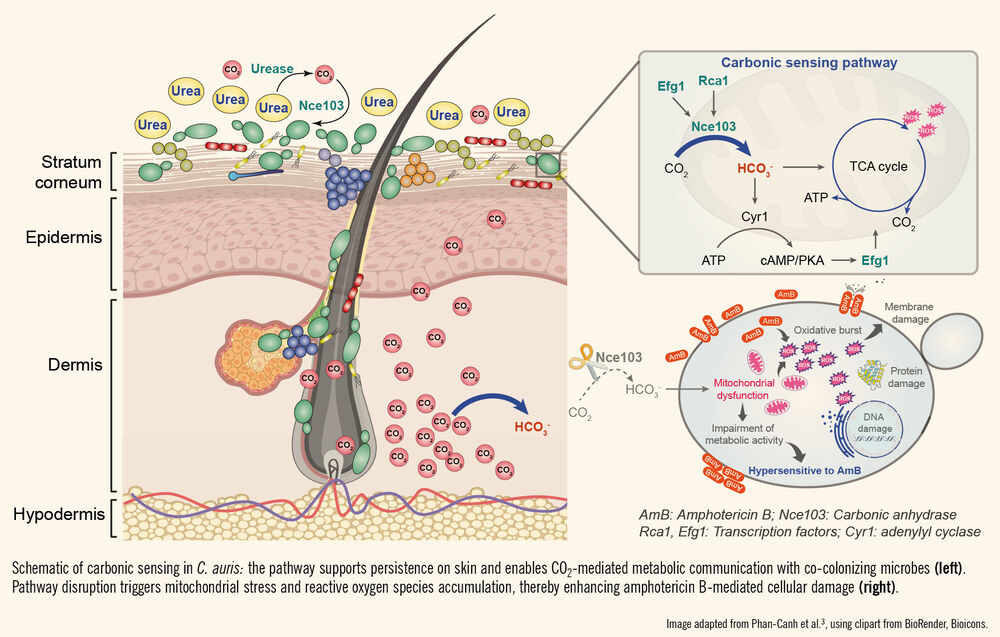
Figure. Carbonic sensing links skin tropism and amphotericin B resistance in Candida auris.
This page preserves the full text and figure from the print magazine. The complete issue is archived with the website; the original publisher page remains linked for attribution.
Article highlights
- Candida auris uses carbonic anhydrase-mediated CO₂ fixation to fuel central energy metabolism, thereby sustaining fitness and persistence on human skin.
- Candida auris skin tropism benefits from metabolic communication with microbiome bacteria to scavenge bacterially derived CO₂.
- Blocking the carbonic-sensing pathway sensitizes Candida auris to amphotericin B, in part by debilitating mitochondrial cytochrome bc1 activity—an Achilles’ heel subject to pharmacological targeting, as shown with the lead compound Inz-5.
Since its first report in 2009, Candida auris has spread to more than 60 countries, causing recurrent hospital outbreaks with life-threatening infections.1 Its remarkable skin tropism facilitates transmission via skin-to-skin contact and contaminated healthcare environments.1 Pronounced antifungal resistance complicates control (approximately 90% to fluconazole, 30–60% to amphotericin B [AMB], and 2–8% to echinocandins).1 Considering these threats, the World Health Organization lists C. auris as a “critical priority” pathogen.2
Identifying drug targets linked to carbonic sensing
Our recent cover-featured Nature Microbiology study used integrated multi-omics to dissect C. auris skin tropism and multidrug resistance. We confirmed multiple resistance mechanisms, including elevated antifungal transporters (e.g., Cdr1 and Mdr1) and the lipid exchange protein Pdr16, contributing to azole and AMB resistance.1,3,4 However, single deletions of highly expressed transporters had little effect on susceptibility, suggesting that pan-resistance may engage combinatorial mechanisms rather than a single efflux pathway.3
To identify a tractable target that could both restore AMB activity and limit skin colonization, proteo-transcriptomics identified Nce103, a Candida-specific carbonic anhydrase highly expressed in a resistant—but not sensitive—strain. Nce103 converts CO₂ to bicarbonate, a signal that activates the cAMP-PKA pathway and downstream Efg1, which is critical to fitness and mitochondrial function.5 Bicarbonate also links carbonic sensing to central energy metabolism by feeding into the tricarboxylic acid cycle.6
Strikingly, disrupting this axis resensitized C. auris to AMB and helps explain the high frequency of AMB resistance. Consistently, elevated CO₂ increased AMB resistance across clinical isolates, implying that standard in vitro testing may underestimate in vivo resistance given higher CO₂ levels in blood and deep tissues.3
To identify CO₂-independent downstream mechanisms, we interrogated mitochondrial pathways and uncovered a functional link between carbonic sensing and the cytochrome bc1 complex. Disrupting Rip1, a catalytic bc1 subunit, reduced fungal fitness and increased AMB sensitivity. As the classic bc1 inhibitor antimycin A is too toxic for therapeutic use, we tested the fungal-selective inhibitor Inz-5. In checkerboard assays across diverse clinical isolates, Inz-5 showed synergistic activity with AMB, supporting bc1 inhibition as a promising antifungal strategy.3,7
Carbonic sensing regulates skin tropism
As C. auris moves from the skin surface to blood and deep tissues, it encounters much higher CO₂ levels (approximately 0.04% in ambient air versus more than 5% in host tissues). Facing high CO₂, C. auris can bypass the need for carbonic sensing, suggesting that this pathway is most critical in low-CO₂, nutrient-limited niches such as the skin.3
In ex vivo human skin models, disrupting carbonic sensing markedly impaired colonization and biofilm formation. Consistently, across clinical isolates spanning all five major clades, elevated CO₂ strongly enhanced growth under nutrient-limiting conditions that mimic the skin niche.3 Together, these data suggest that carbonic sensing supports energy metabolism and facilitates persistence on skin and healthcare surfaces.
Notably, C. auris is frequently co-colonized with urease-producing nosocomial bacteria, particularly Klebsiella pneumoniae and Proteus mirabilis.8,9 Because urease converts sweat urea into ammonia and CO₂, we hypothesized that microbiome-derived CO₂ benefits C. auris. Indeed, urease-positive bacteria reduced growth of carbonic-sensing-deficient C. auris in co-culture, whereas urease-negative bacteria did not.3 These findings support a metabolic cross-talk in the skin microbiome whereby bacteria-derived CO₂ supports fungal carbonic sensing, thus promoting C. auris colonization and transmission.
Conclusion
We identify a carbonic-sensing pathway that links C. auris skin tropism to AMB resistance. This pathway not only shapes drug tolerance but also promotes metabolic cross-talk with co-colonizing skin bacteria via CO₂. Targeting carbonic sensing may therefore help curb C. auris persistence and transmission in healthcare settings.
About the authors
Trinh Phan-Canh focuses on the molecular mechanisms of antifungal resistance and host–pathogen interactions in emerging fungal infections. He applies integrated multi-omics and genetics to dissect the pathogenesis of Candida auris.
Adelheid Elbe-Bürger leads a research group at the Medical University of Vienna. Her team studies the development and function of the immune system in prenatal and adult human skin and has established skin models to investigate disease mechanisms and antimicrobial therapies.
Karl Kuchler is a molecular biologist with a longstanding focus on host–fungal interactions. His team has pioneered systems-level and functional-genomics approaches to fungal virulence, drug resistance, and immune surveillance at Max Perutz Labs Vienna.
References
- Chowdhary A et al. Microbiol Mol Biol Rev. 2026;90(1):e0018722.
- World Health Organization. WHO fungal priority pathogens list to guide research, development and public health action. 2022. View the WHO publication.
- Phan-Canh T et al. Nat Microbiol. 2026;11(2):461–475.
- Phan-Canh T et al. Microbiol Spectr. 2025;13(5):e0265924.
- Glazier VE. Front Cell Infect Microbiol. 2022;12:855229.
- Jitrapakdee S et al. Biochem J. 2008;413(3):369–387.
- Vincent BM et al. Cell Chem Biol. 2016;23(8):978–991.
- Proctor DM et al. Nat Med. 2021;27(8):1401–1409.
- Proctor DM et al. Nature. 2025;639(8056):1016–1023.
Source: SPECTRUM Dermatologie, MedMedia. Full text and figure reproduced from the supplied magazine copy and publisher page.